
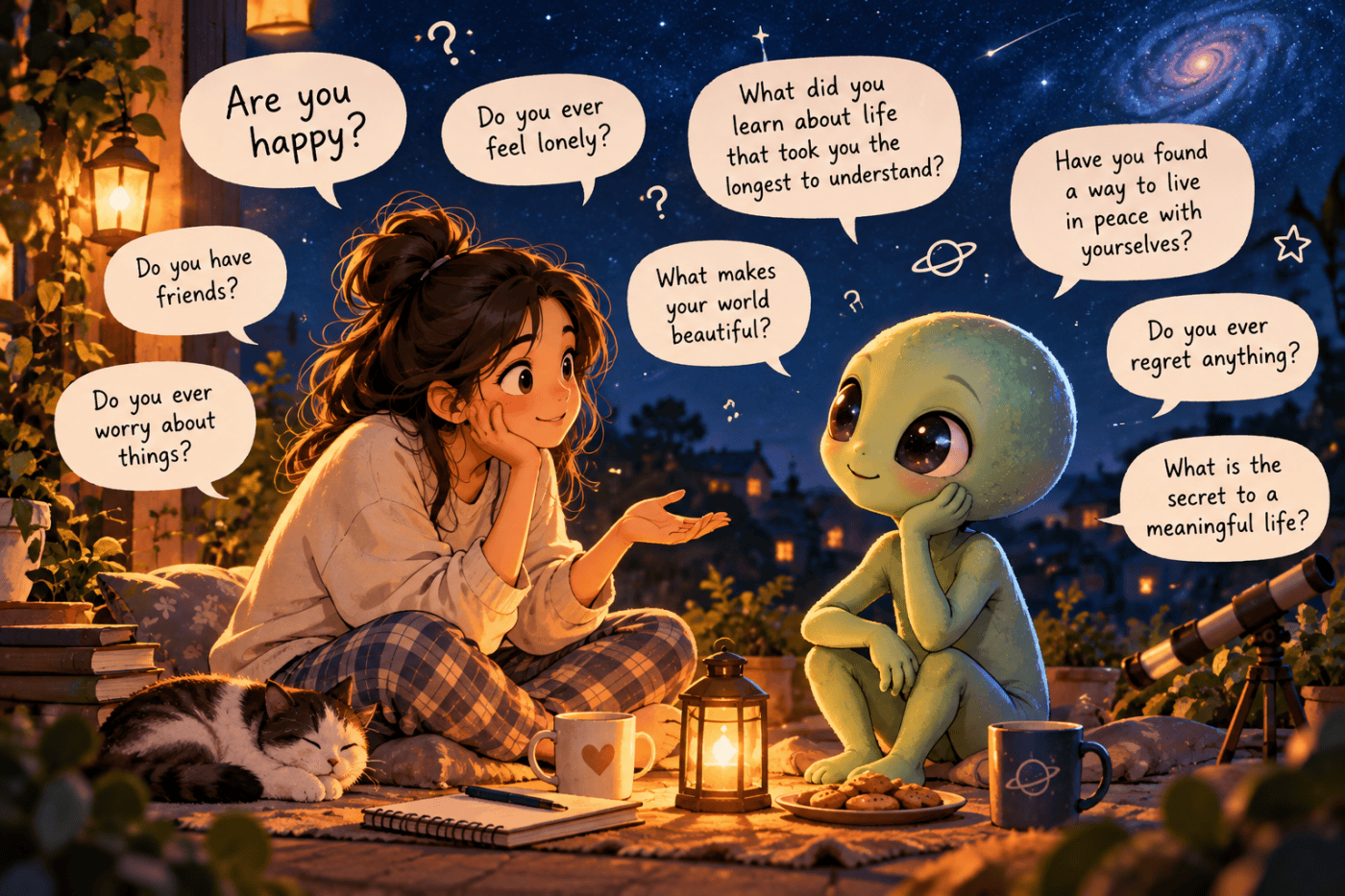
If aliens arrived tomorrow, what’s the first thing you’d ask them?
If an alien knocked on my door tomorrow, I honestly don’t know what would scare me more—the fact that it was standing there, or the fact that I’d probably ask it to wait while I put on proper clothes.
Imagine it.
You open the door expecting a delivery, a neighbour, or someone asking whether you’ve seen their cat.
Instead, there’s a creature from another world looking at you.
For a few seconds, neither of you speaks.
You stare at it.
It stares at you.
And somewhere behind the curtains, your neighbour is already recording everything.
The world would lose its mind.
Scientists would arrive. Governments would hold emergency meetings. News channels would spend twelve hours debating whether the alien looked “friendly.” The internet would do what it does best: turn the most important event in human history into a meme before dinner.
But if, somehow, I were given the first opportunity to speak to this visitor from the stars, I wouldn’t ask where it came from.
I wouldn’t ask how it crossed the universe.
I wouldn’t even ask whether it had seen Earth before.
I’d ask:
“Are you happy?”
It sounds like a strange question for humanity’s first conversation with extraterrestrial life.
But perhaps that’s exactly why I’d ask it.
Because we have spent so much of our history trying to become more intelligent, more powerful and more advanced that we sometimes forget to ask whether any of it is actually making us better at being alive.
Maybe this alien civilization has solved problems we’ve barely begun to understand.
Perhaps they can travel between galaxies.
Perhaps they can cure diseases we fear.
Perhaps they have machines that never run out of battery—which, personally, would convince me they’re several thousand years ahead of us.
But can they sit quietly with themselves?
Can they love someone and be terrified of losing them?
Can they forgive?
Can they laugh until their stomach hurts?
Can they miss someone who isn’t there anymore?
Can they look at a sunset and forget, for a moment, about everything they were supposed to do?
“Perhaps the greatest sign of an advanced civilization isn’t how far it can travel, but how gently it can live.”
And I wonder whether they would understand our strange little human habits.
Our habit of saying “I’m fine” when we’re not.
Our habit of postponing happiness until after exams, after success, after money, after everything becomes perfect.
Our habit of taking photographs of beautiful moments because we’re afraid we’ll forget them—and sometimes forgetting to actually live the moment we’re photographing.
Maybe they’d look at us and realise something we’ve been too busy to notice:
We have spent centuries trying to conquer the universe while struggling to make peace with ourselves.
So if that alien stood at my door tomorrow, I’d listen carefully to its answer.
Because perhaps the most important thing an extraterrestrial visitor could bring us wouldn’t be technology, secrets or proof that we’re not alone.
Perhaps it would bring us a different way of looking at the life we already have.
And maybe, after all the questions about distant planets and distant galaxies, I’d ask one last thing:
“What did you learn about being alive that took your civilization the longest to understand?”
I have a feeling I’d be willing to wait a very long time for that answer.
Thought to Ponder
If an intelligent life-form from another galaxy watched your life for just twenty-four hours, what would you hope it noticed—and what would you hope it never misunderstood?


Leave a comment