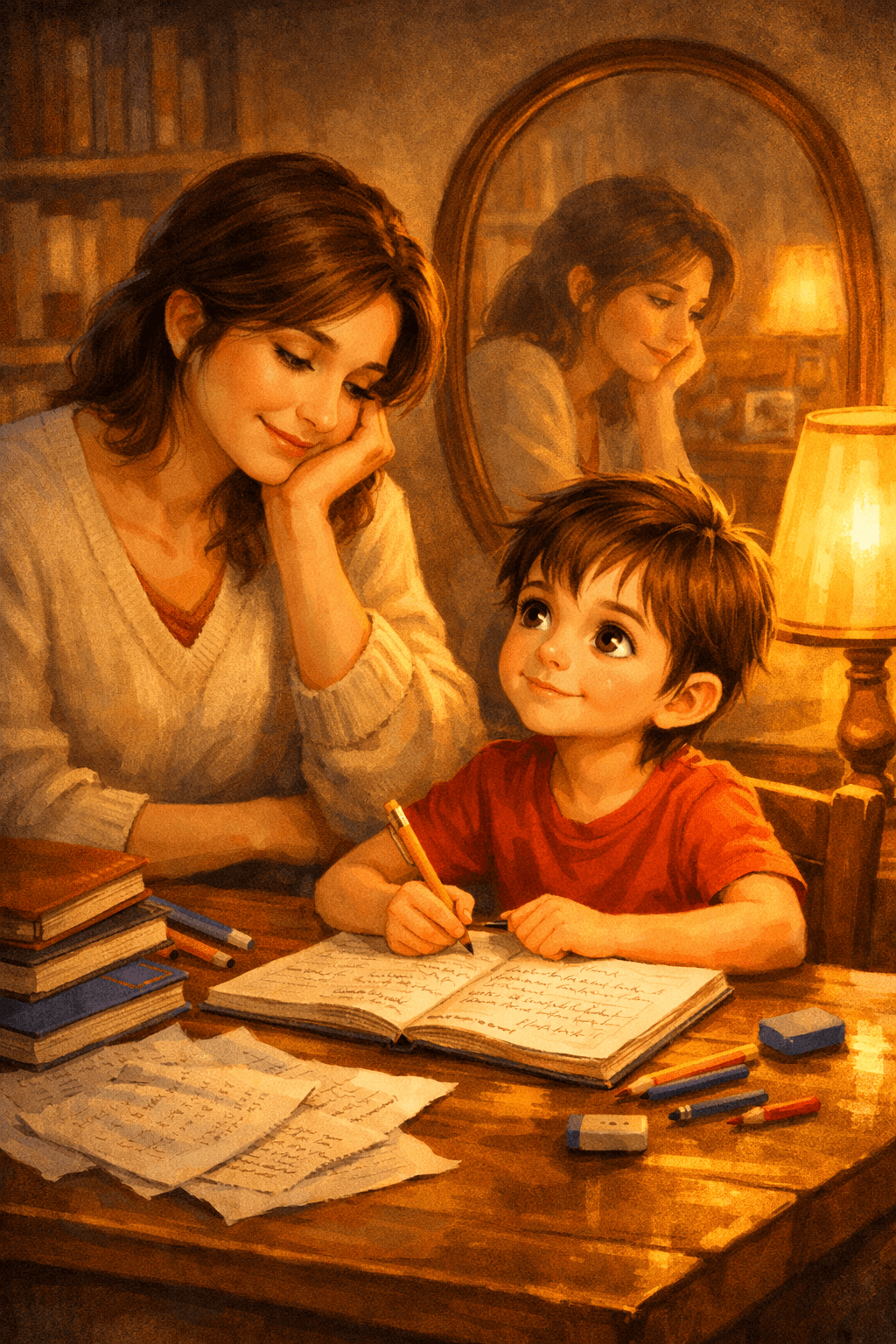
Today, I was sitting with my 7-year-old son, going through his notebook. Like most parents, I want him to do well in school and build good habits.
His handwriting, however, looked like a group of overly enthusiastic ants had decided to organize a relay race across the page.
With the best intention, I said,
“Your handwriting should be better.”
He paused. His eyes filled slightly, and then came the sentence that froze me for a moment:
“But you said we should not judge others. Why are you judging me?”
Silence.
In that brief moment, I was no longer a parent correcting homework. I was a man being gently cross-examined by a 7-year-old who had mastered the art of using truth without filters.
And honestly… he had a point.
That moment revealed something every parent eventually discovers:
Children don’t just hear our words. They store them like living rules. And one day, they play them back to us — uncut, unedited, and absolutely fair.
There is a beautiful line in The Little Prince:
“Grown-ups never understand anything by themselves, and it is tiresome for children to keep providing explanations.”
In a way, my son wasn’t arguing about handwriting at all. He was asking something much deeper:
“Are your values only for me to follow — or do they also apply to you when I am the one struggling?”
That question deserves reflection, not correction.
Psychology calls this mirrored learning — children often reflect our emotional tone, language, and beliefs back to us. When we are harsh, they learn harshness. When we are thoughtful, they learn reflection.
There is also a powerful quote often attributed to Haim Ginott:
“Children are like wet cement. Whatever falls on them makes an impression.”
But today, I would add this:
“Parents are like mirrors. Whatever we say to children eventually reflects back at us.”
In that moment, I smiled and said:
“You’re right to remind me. I wasn’t trying to judge you. I was trying to help you improve your handwriting. I should have said it better. Let’s work on it together.”
The tension softened immediately.
No argument.
No lecture.
Just connection.
And something interesting happened — he relaxed, picked up the pencil again, and actually tried a little more carefully.
The irony wasn’t lost on me.
I had set out to improve his handwriting.
Instead, he improved my awareness.
Five Ways to Handle Moments Like This
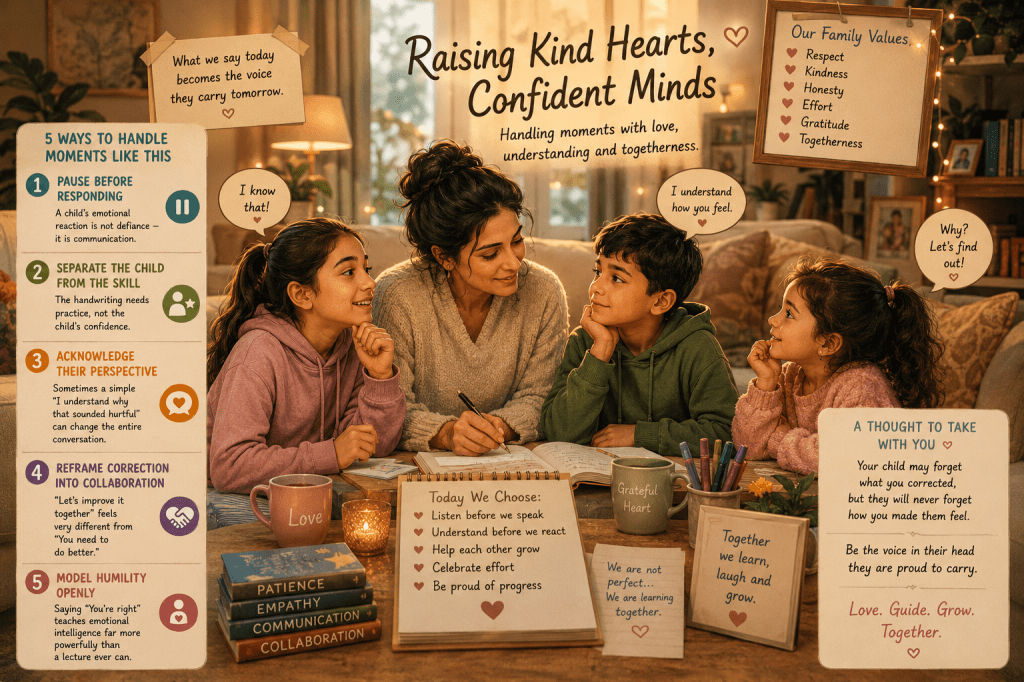
A Thought to Take With You
Years from now, your child may not remember whether his handwriting was neat or messy.
But he will remember how it felt to be corrected.
Was he judged — or guided?
Was he criticized — or understood?
Was home a place where mistakes felt like failures — or part of learning?
So maybe the real question is not:
“How do I make my child write better?”
But rather:
“What kind of voice will my child carry in his head because of how I spoke to him today?”
Because long after the notebooks are forgotten, the words we use become the inner voice our children live with.
And sometimes, the smallest person in the room teaches the biggest lesson.


Wow! Children nowadays…!
LikeLiked by 1 person
😊What to say, sometimes they think beyond our imagination 🤔
LikeLiked by 1 person