

Sometimes, all it takes is one day, a room full of people, and a few honest conversations to make you look at your own career differently.
Have you ever attended an event expecting the usual formal conversations, polite smiles, and corporate presentations, only to walk away with something far more valuable than you anticipated?
That was me recently.
Working from home has become a regular part of my professional life. My colleagues are often familiar faces on a screen, and teamwork usually means collaborating through emails, chats, and virtual meetings. So, when I got the opportunity to visit the office for a leadership meet and interact with my colleagues and leadership team from the USA, I was genuinely excited.
But I didn’t expect to enjoy it as much as I did.
Fun, laughter, learning, and meaningful conversations—all under one roof in a single day! The experiences shared by our leaders were incredible. What struck me most was how familiar lessons suddenly felt different when explained through real-life experiences.
Sometimes, we don’t need entirely new lessons. We simply need someone to help us see the old ones through a new lens.
Here are four lessons that stayed with me long after the meeting ended.
1. Participate and Deliver: Let Your Work Be Seen
One of the key messages shared by our leaders was simple: Participate and deliver.
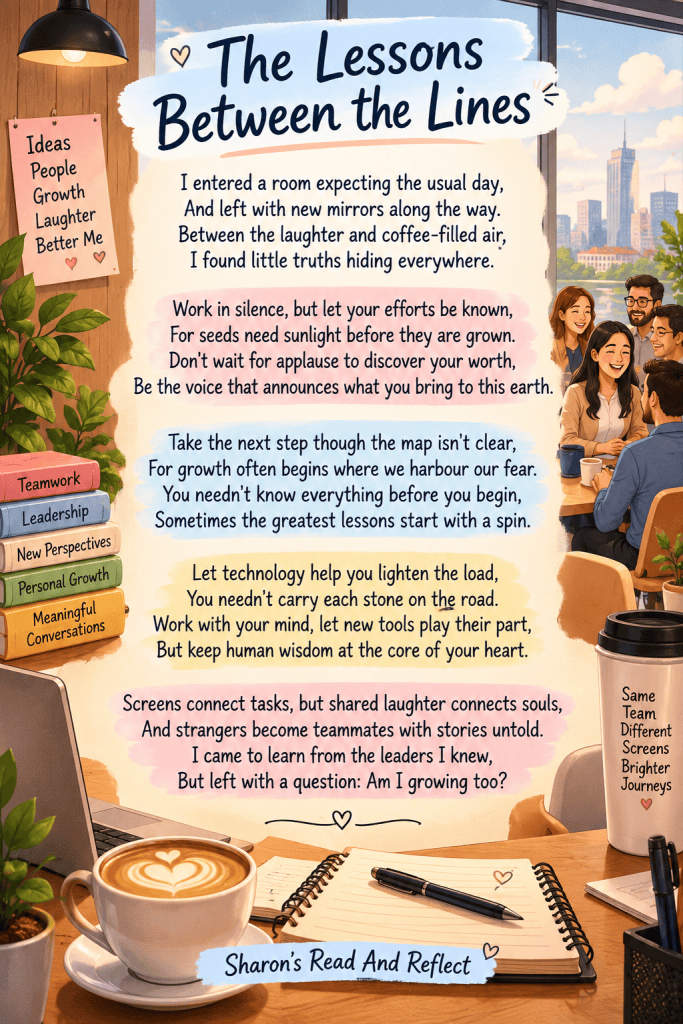
We often believe that if we work sincerely, deliver good results, and mind our own business, our work will automatically speak for itself. Unfortunately, that isn’t always how things work.
Everyone has responsibilities and deadlines. What makes us stand out is how we participate, ask questions, share ideas, contribute to discussions, and communicate our results.
Imagine two employees delivering equally good work. One actively participates in meetings and shares progress, while the other quietly completes every task. Both are capable, but one person’s contributions may be easier to recognise.
This reminded me of Austin Kleon’s book Show Your Work!, which encourages us to share our ideas and work rather than keeping everything hidden.
As the popular Hindi saying goes, “Jo dikhta hai, woh bikta hai”—what is seen gets noticed.
Of course, visibility alone isn’t enough. We must also deliver results. The key is to find the balance between doing meaningful work and helping others understand the value we bring.
We don’t have to be the loudest person in the room. We simply have to participate meaningfully and allow our work to be seen.
Our work creates value, but our visibility helps others recognise it.
2. Be Your Own Advocate: Don’t Wait for Others to Tell Your Story
How often do we expect people to notice our efforts without actually telling them what we have accomplished?
We hope our managers notice our extra efforts, remember the challenges we’ve overcome, and recognise the contributions we make. Sometimes they do. Sometimes they don’t—not necessarily because they don’t care, but because everyone is busy managing their own responsibilities.
That’s why being our own advocate matters.
Being your own advocate means communicating your achievements, expressing your opinions, asking for opportunities, and making your professional aspirations known. It means being assertive without being aggressive.
I was reminded of The Confidence Code by Katty Kay and Claire Shipman, which explores confidence and the importance of moving beyond hesitation and self-doubt.
We don’t always have to wait until we feel completely confident before speaking up. Sometimes, confidence develops because we take that first step.
For example, instead of assuming your manager knows how much effort you invested in a project, explain your contribution and the impact it created. If you have an idea, share it. If you’re interested in a new responsibility, express that interest.
Of course, supportive leaders and mentors make a tremendous difference. But we cannot make our growth entirely dependent on someone else noticing our potential.
Don’t wait for someone to discover your value when you can learn to communicate it yourself.
3. Take Risks: You Don’t Need to Know Everything Before You Begin
Our brains are wonderful at finding reasons to stay comfortable.
A new responsibility appears, and suddenly we remember everything we don’t know. An unfamiliar opportunity comes along, and we start imagining everything that could go wrong.
We tell ourselves we’ll try when we’re more experienced, knowledgeable, or confident.
And sometimes, while we’re waiting to feel ready, the opportunity passes us by.
One insight shared during the leadership meet was that we don’t always need to know everything before accepting a challenge. Sometimes, understanding the basics and being willing to learn along the way is enough to begin.
This brought to mind Carol S. Dweck’s book Mindset, which explores how our beliefs about our abilities influence the way we approach challenges.
Imagine being offered a leadership role for the first time. You may understand the technical aspects but feel uncertain about managing people or making difficult decisions.
You could turn it down because you don’t feel ready. Or you could accept the challenge, seek guidance, and develop those skills along the way.
Taking risks doesn’t mean being reckless. It means considering the consequences and being willing to step beyond familiar boundaries when an opportunity is worth pursuing.
And what if we fail? We learn, make adjustments, and begin again.
You don’t have to know everything before you begin; you have to be willing to learn what you don’t yet know.
Sometimes, the real risk isn’t failing at something new. It’s becoming so comfortable with what we already know that we stop giving ourselves opportunities to grow.
4. Use AI in Your Daily Life: Work Smarter, Not Harder
Just when I thought the leadership meet had given me enough food for thought, another interesting lesson came up: why not use AI to make our work easier?
We live in a world where technology is evolving rapidly, yet many of us are still hesitant to embrace it.
A humorous analogy shared during the discussion made me smile: either learn to cook, let someone else cook, or ask someone who knows how to cook to do it for you—preferably someone who won’t burn the kitchen down!
It was a funny way of looking at the choices available to us. Why struggle with everything alone when there’s a smarter way to get things done?
Think about the time we spend drafting emails, organising information, brainstorming ideas, or preparing presentations. AI tools can help with many of these tasks, leaving us more time for work that requires human judgement, creativity, and connection.
Of course, using AI wisely matters. We must verify important information, protect confidential data, and follow our organisation’s policies. AI can assist us, but accountability for our decisions remains ours.
A calculator makes calculations easier, but we still need to understand what we’re calculating. Similarly, AI can improve our efficiency without replacing our thinking.
The goal isn’t to replace our abilities with technology; it’s to make our abilities go further.
If a tool can save us time and effort, why not learn to use it safely and responsibly?
Beyond the Lessons: The Value of Meeting in Person
As valuable as the leadership insights were, meeting my colleagues in person was equally memorable.
Working from home offers flexibility, but our interactions often remain limited to screens, scheduled meetings, and work-related conversations.
And then came one of the funniest moments of the day!
I never imagined I would struggle to recognise colleagues I interact with almost daily. We were so used to seeing each other on screens that, for a moment, we felt like complete strangers! We exchanged names, realised who was who, and burst into laughter. Who knew recognising colleagues could become a team-building activity in itself?
Beyond the laughter, the day gave us an opportunity to share experiences, appreciate different perspectives, and understand the people behind our professional roles. Listening to senior leaders share their journeys also reminded me that leadership isn’t about having all the answers; it’s about learning, adapting, and growing.
For those of us working remotely, gatherings like these renew our sense of belonging and remind us that, despite the distance, we are part of the same team.
Remote work connects our tasks; shared experiences help us understand the people behind them.
I returned with valuable insights, wonderful memories, and a fresh perspective on my own growth.
A Thought to Ponder
Self-care helps you feel better, while self-awareness helps you grow better. Sometimes, growth begins when we have the courage to face what we would rather avoid.
Perhaps growth isn’t always about a promotion, a new job, or a major achievement. Sometimes, it begins when we recognise that we need to speak up, advocate for ourselves, embrace new challenges, or learn to work smarter.
I attended the leadership meet expecting to learn from others. I returned thinking about the changes I could make within myself.
The most interesting part? I already knew many of these lessons. But hearing them from experienced leaders helped me see them differently.
Because knowing something and practising it are two very different things.
So, here’s a question worth reflecting on: Are we waiting for someone to notice our potential, or are we actively creating opportunities to demonstrate it?
Sometimes, the next step in our growth isn’t learning something entirely new. It’s having the courage to practise what we already know.


Leave a Reply