
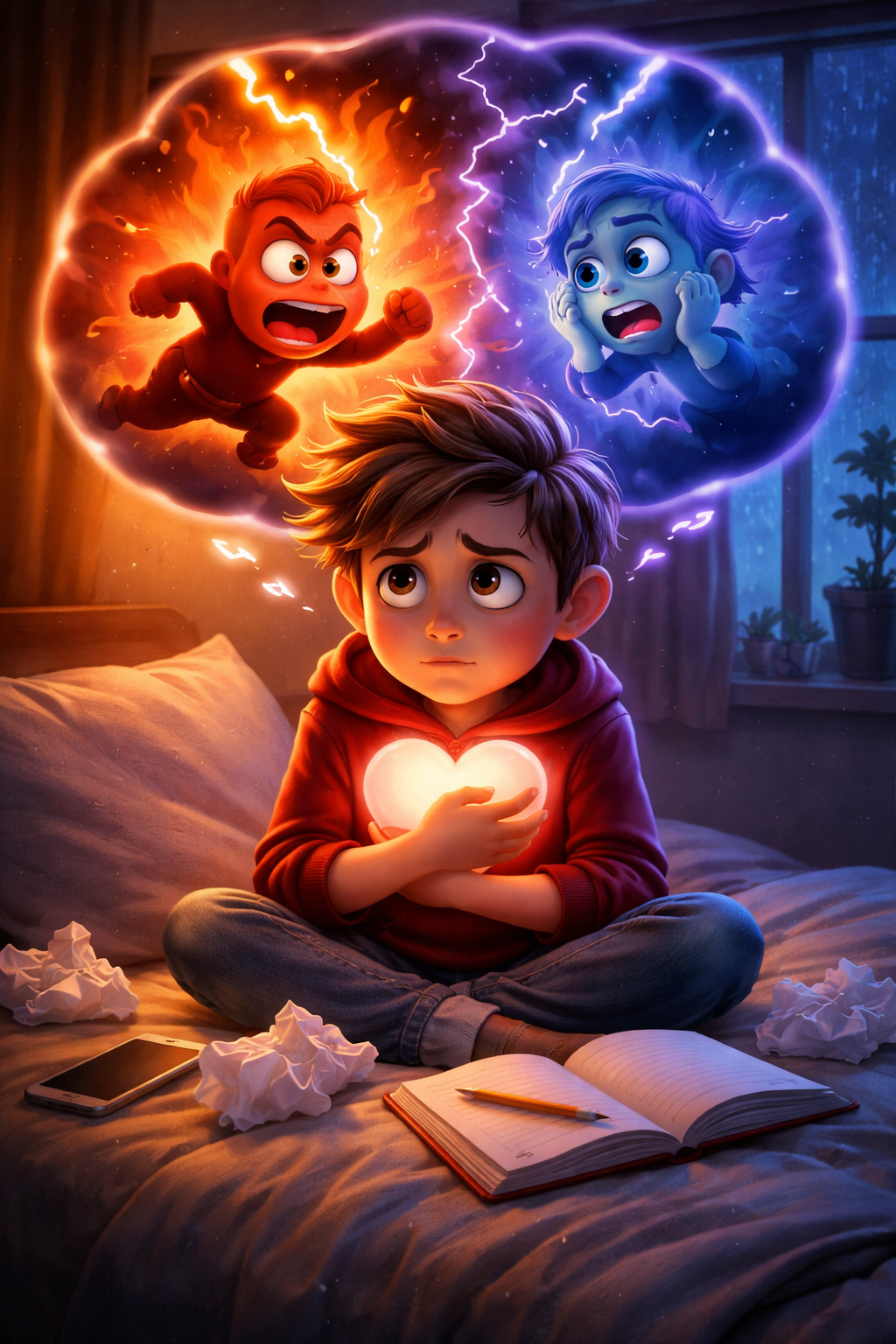
There are wars fought with swords, wars fought with words… and then there are wars fought silently inside the human heart. The third one, unfortunately, has the highest population.
Emotional conflict is like having two roommates in your mind who absolutely cannot stand each other. One says, “Be strong.” The other whispers, “Just cry a little.” One says, “Move on.” The other stubbornly replies, “But what if…?”
And there you are, standing between them like a confused referee holding a whistle.
Someone once wisely said, “The loudest battles are often fought in complete silence.”
We all face these invisible wars — guilt fighting forgiveness, hope wrestling with fear, love arguing with pride. The strange part? Both sides often make perfect sense.
You want to forgive someone… but the memory still hurts.
You want to move on… but your heart still waits for an explanation.
You want peace… but your thoughts are holding a protest march.
Emotional conflicts are not signs of weakness. They are signs that your heart is alive and your conscience is awake.
In The Alchemist, the shepherd Santiago struggles between the comfort of staying with his sheep and the fear of chasing a dream. His inner conflict teaches him that growth often begins where certainty ends.
Similarly, in Man’s Search for Meaning, Frankl writes about surviving unimaginable suffering by choosing how to respond internally. His words remind us that even when circumstances trap the body, the mind still holds the power to interpret and heal.
And who can forget Harry Potter and the Order of the Phoenix, where Harry struggles with anger, confusion, and loneliness? At one point Dumbledore gently reminds him,
“Understanding is the first step to acceptance, and only with acceptance can there be recovery.”
Books have a funny way of holding mirrors to our minds.
But let’s add a little humour to this serious topic.
Handling emotional conflict is sometimes like trying to close 37 browser tabs in your brain. You start calmly.
Then suddenly one tab says, “Remember that embarrassing thing you did in 2009?”
Another pops up saying, “Did you reply to that message?”
A third whispers, “What if you said the wrong thing?”
And before you know it, your brain has turned into an emotional customer care center with no lunch break.
Yet the secret to handling emotional conflict is surprisingly simple: sit with it instead of fighting it.
Feel the emotion. Write it down. Talk about it. Walk it out. Cry if needed. Laugh when possible.
As the writer Rainer Maria Rilke once wrote,
“Be patient toward all that is unsolved in your heart.”
Conflicts inside us are not enemies; they are teachers wearing slightly uncomfortable shoes.
Every unresolved feeling is simply a message waiting to be understood.
And slowly, very quietly, when you listen long enough, the war inside begins to soften into wisdom.
Because peace does not come when emotions disappear.
It comes when we learn how to hold them without breaking.
Thought to ponder
What if emotional conflicts are not problems to eliminate… but conversations within ourselves that are waiting to be heard?
 Sharon's Read And Reflect
Leave a comment