
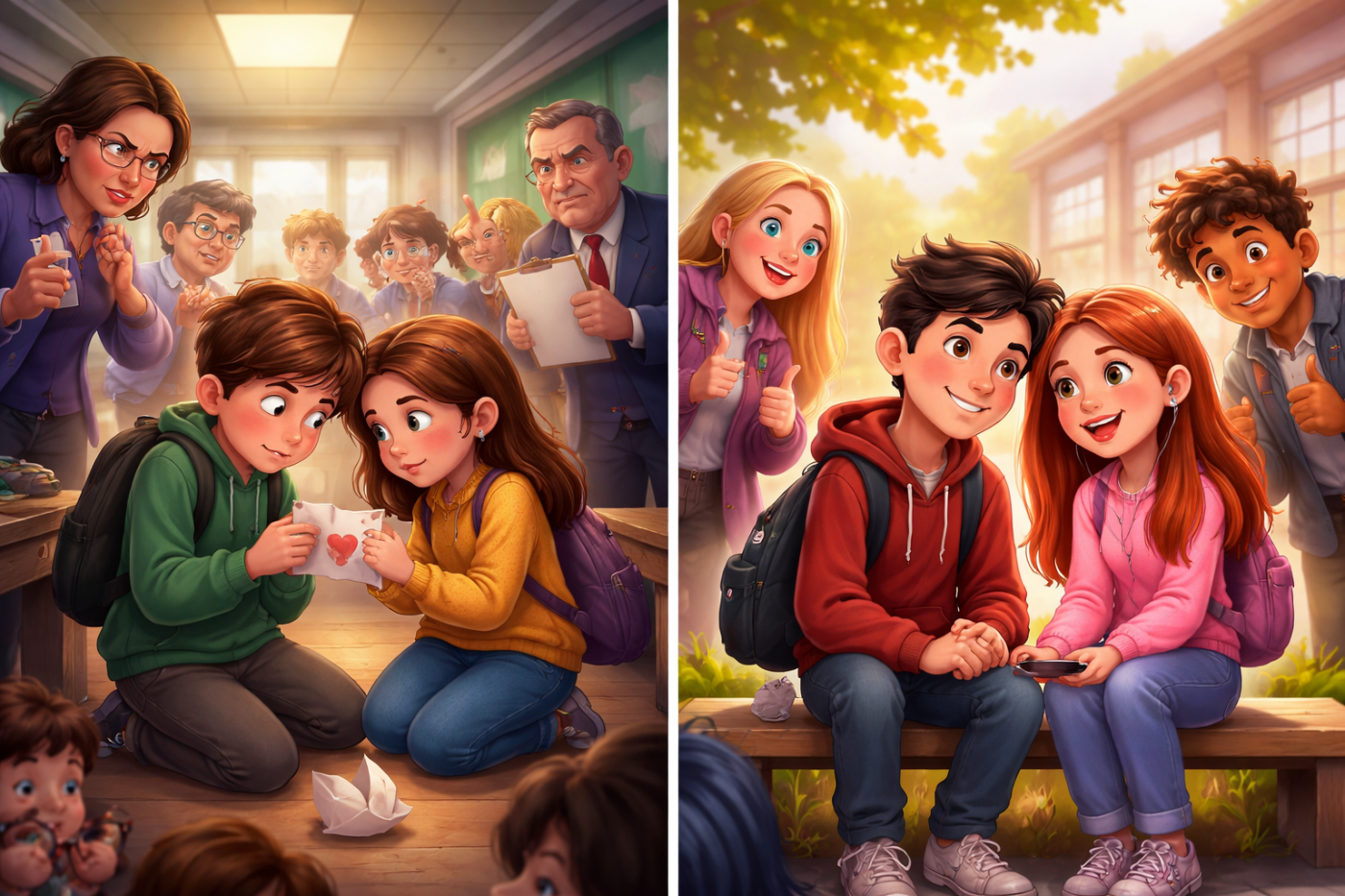
There was a time—not in the Stone Age, but in the early millennial classroom—when love in school came with a warning label.
If a girl and a boy spoke for more than three minutes, the entire class would behave like investigative journalists. If someone had a “partner,” it was treated less like a friendship and more like a crime report.
Back then, love in school was not a chapter in the syllabus. It was a “distraction.” A “spoiler.” A “red mark in character certificate.”
“If you have a boyfriend, your future is gone,” they said.
“If you have a girlfriend, your marks will drop,” they warned.
Love wasn’t Romeo and Juliet. It was more like a disciplinary meeting.
In millennial classrooms, emotions were kept in pencil boxes — hidden, zipped, and never opened in public. If someone blushed, the teasing would begin. If someone exchanged notes, the rumor mill worked faster than the school bell.
It was almost funny.
We were old enough to solve algebra but apparently too young to understand affection. We memorized chemical formulas, yet we were told feelings were “dangerous chemicals.”
“Focus on studies,” they repeated like a sacred mantra.
“Love can wait.”
And so love waited. It waited in folded papers, in library glances, in missed bus stops, in songs heard secretly through wired earphones.
For many millennials, school-age love was treated like rebellion. It was painted in dark colors — as if liking someone meant losing direction. As if affection automatically erased ambition.
But here’s the humorous part: most of us weren’t planning weddings at sixteen. We were just trying to understand why our heart suddenly did gymnastics when someone smiled.
We weren’t bad. We were human.
Now look at the present generation.
Things have changed. Conversations have opened. Parents are more aware. Schools discuss emotional well-being. Love is no longer always treated as a villain in the academic story.
There is more freedom of thought.
Young people today can say, “I like someone,” without being labelled irresponsible. They talk about boundaries, consent, respect. The dialogue has shifted from fear to understanding.
Of course, challenges still exist. But the tone is softer.
Instead of, “You are spoiling your life,” it is slowly becoming,
“Are you emotionally ready?”
Instead of secrecy, there is guidance.
Instead of shame, there is conversation.
Millennials walked so Gen Z could talk.
Looking back, it almost feels adorable. All that panic over hand-holding! All that drama over shared tiffin boxes!
Maybe the problem was never love. Maybe it was the fear of it.
Because love at any age is not automatically destruction. It is experience. It is growth. It is learning to care. Sometimes it ends. Sometimes it teaches. Sometimes it simply passes like a school bell ringing between two periods.
Love was never the enemy of success. Immaturity without guidance was.
And perhaps that is what has changed — not love itself, but how we look at it.
“Freedom of thought does not mean freedom from responsibility.”
It simply means space to understand feelings without being shamed for having them.
Thought to ponder
If we had been taught how to handle emotions instead of being told to hide them,
would we have grown wiser hearts sooner?
Maybe love never needed a warning label.
Maybe it just needed a conversation.
 Sharon's Read And Reflect
Leave a comment