
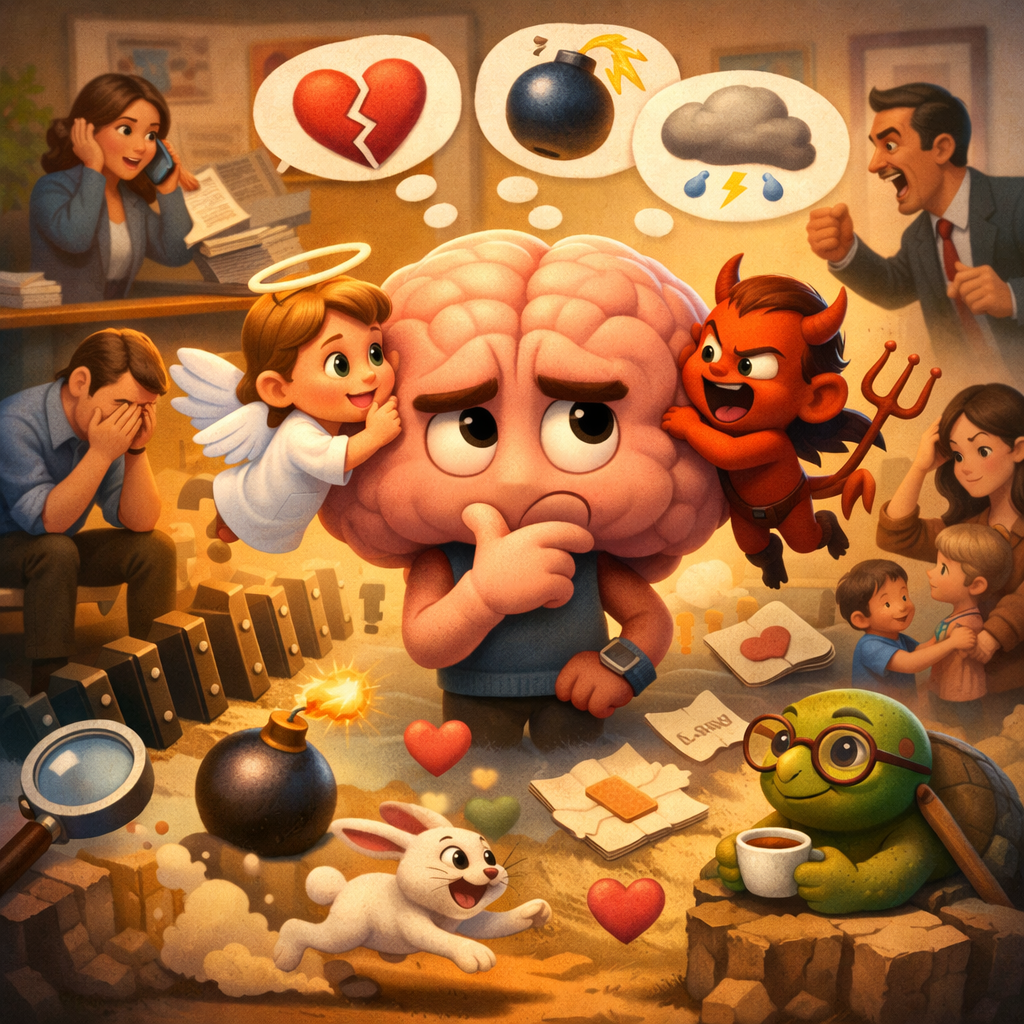
Have you ever noticed how our mind deserves an Olympic medal for high jump? It doesn’t walk to conclusions. It doesn’t jog. It leaps. Without warm-up. Without stretching. Straight into drama.
Someone doesn’t reply to your message?
“Oh, they’re ignoring me.”
Your friend walks past without smiling?
“She’s upset with me.”
A colleague sounds serious?
“He must be angry.”
Our mind is like that one relative at a wedding who whispers, “Something is wrong,” even before the bride enters.
Why does this happen?
Because the brain loves shortcuts. Psychologists call them “mental shortcuts,” but I like to call them “instant noodles thoughts.” They’re quick, convenient, and mostly undercooked. The brain thinks it is protecting us from danger. A sudden silence? Threat. A changed tone? Warning. A delay? Rejection.
“The mind would rather be fast than accurate.”
Panic slips in quietly. A tiny misunderstanding becomes a full-blown movie in our head. Background music included. By the time reality enters, we have already written the climax.
Over the past years, I’ve realised something very humbling: most of our conclusions are stories we create without complete information. We judge based on one expression, one word, one moment.
But what if that person you are silently judging is fighting a battle you cannot see?
Maybe the friend who didn’t smile had a sleepless night.
Maybe the colleague who sounded harsh is worried about a sick parent.
Maybe the person who didn’t respond is drowning in responsibilities.
“We see behaviour. We don’t see burdens.”
And that is where we often fail.
There were times I spoke quickly, reacted instantly, assumed confidently… only to realise later how wrong I was. The guilt that follows is heavier than the original situation. Because once words leave our mouth, they don’t return with an apology note.
Think a thousand times before speaking anything about anyone.
It sounds exaggerated. A thousand times? Yes. Maybe not literally a thousand — but at least pause long enough to let wisdom enter the room before ego starts talking.
Silence is often kinder than a rushed opinion.
Judgement is easy. Understanding takes effort.
Our mind panics because it fears uncertainty. It wants answers immediately. It doesn’t like “I don’t know.” So it fills the blanks with imagination — usually negative imagination.
But maturity begins when we tell our mind,
“Calm down. Not every silence is rejection. Not every tone is attack. Not every delay is disrespect.”
Sometimes people are simply tired. Sometimes they are overwhelmed. Sometimes they are just human.
And so are we.
The more we slow down our conclusions, the lighter our heart becomes. Because we stop carrying unnecessary guilt for thoughts that were never true.
“Quick assumptions build quick regrets.”
So next time your mind tries to jump — gently pull it back. Ask, “Do I have the full story?” If the answer is no, then wait.
Because kindness is not only in what we say — it is also in what we choose not to assume.
Thought to ponder:
If someone judged you only by your worst five minutes, would that describe your entire life? Then why do we do that to others?


For a happy life worth practicing what you have shared Sharon Clara. Thank you🙏. All the best 😘
LikeLiked by 1 person
Thank you so much 😊
LikeLike