
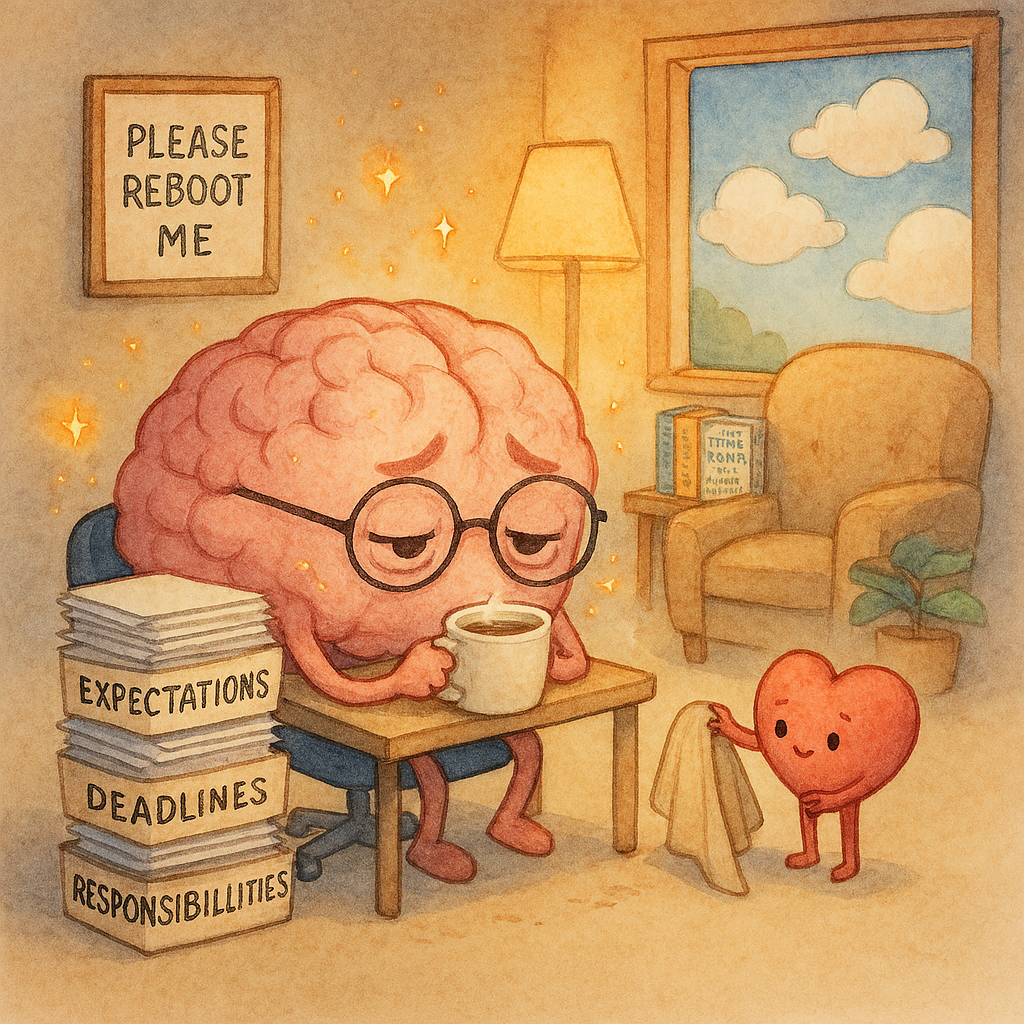
If burnout had a face, it would probably look like a tired parent hiding in the bathroom for five minutes of peace or an office employee pretending to type vigorously while actually scrolling through holiday packages they can’t afford. Burnout is the mind’s version of saying, “Okay, enough. I’m done. Reboot me or lose me.”
Psychologically, burnout isn’t just “being tired.” It’s a slow emotional leak, like a balloon that doesn’t pop dramatically but simply deflates with a quiet pfff. It sneaks in when demands exceed capacity for too long—mentally, emotionally, spiritually, even socially.
As Adam Grant writes in Think Again,
“We need to unclutter the mind the way we unclutter a messy room.”
Burnout is what happens when the mind becomes a warehouse and we keep stuffing more boxes into it, hoping space will appear magically.
Why Does Burnout Happen?
At its core, burnout is a psychological imbalance. Our brain is wired for stress in short bursts—run from a tiger, save your child from a fall—but not for endless deadlines, Teams messages from manager, 47 responsibilities before lunch, and the pressure to “stay productive” like an inspirational Instagram reel.
The psychologist Herbert Freudenberger, who coined the term burnout, described it as a state of exhaustion caused by excessive demands on energy, strength, or resources.
The irony?
We often overwork to feel in control, and burnout is the mind’s way of fiercely taking that control back.
In The Body Keeps the Score, Dr. Bessel van der Kolk reminds us:
“Your body will tell the truth even when your mind tries to lie.”
So while you might say, “I’m fine,” your body says, “Sit down immediately or I will make you.”
The Internal Drama: Motivation vs. Exhaustion
There are three psychological villains that commonly gang up to cause burnout:
1. Perfectionism – the voice that whispers,
“Do more. Do better. Do it perfectly. Also, smile while doing it.”
As Brené Brown beautifully puts it,
“Perfectionism is not the path to achievement; it’s the path to misery.”
2. Lack of boundaries – When we say yes to everything, even things we don’t believe in, want, or enjoy.
Like the character Aibileen from The Help says,
“You is kind, you is smart, you is important.”
But nowhere does it say, “You is obligated to please everyone.”
3. Chronic stress – The silent alarm that never turns off.
It tricks your brain into thinking survival mode is normal life.
Signs That Your Brain Is Overcooked
- You feel tired even after resting.
- You get irritated at small things (like someone breathing too loudly).
- You lose interest in things you once loved.
- Motivation takes a vacation without informing you.
- Burnout is not weakness; it’s a signal.
Thought to Ponder
If burnout is our mind’s way of begging us to pause, then perhaps the real question is:
“What would life look like if we rested before we reached breaking point?”
And maybe—just maybe—the bravest thing we can do is to slow down before our brain sends us another warning letter.
 Sharon's Read And Reflect
Leave a comment