
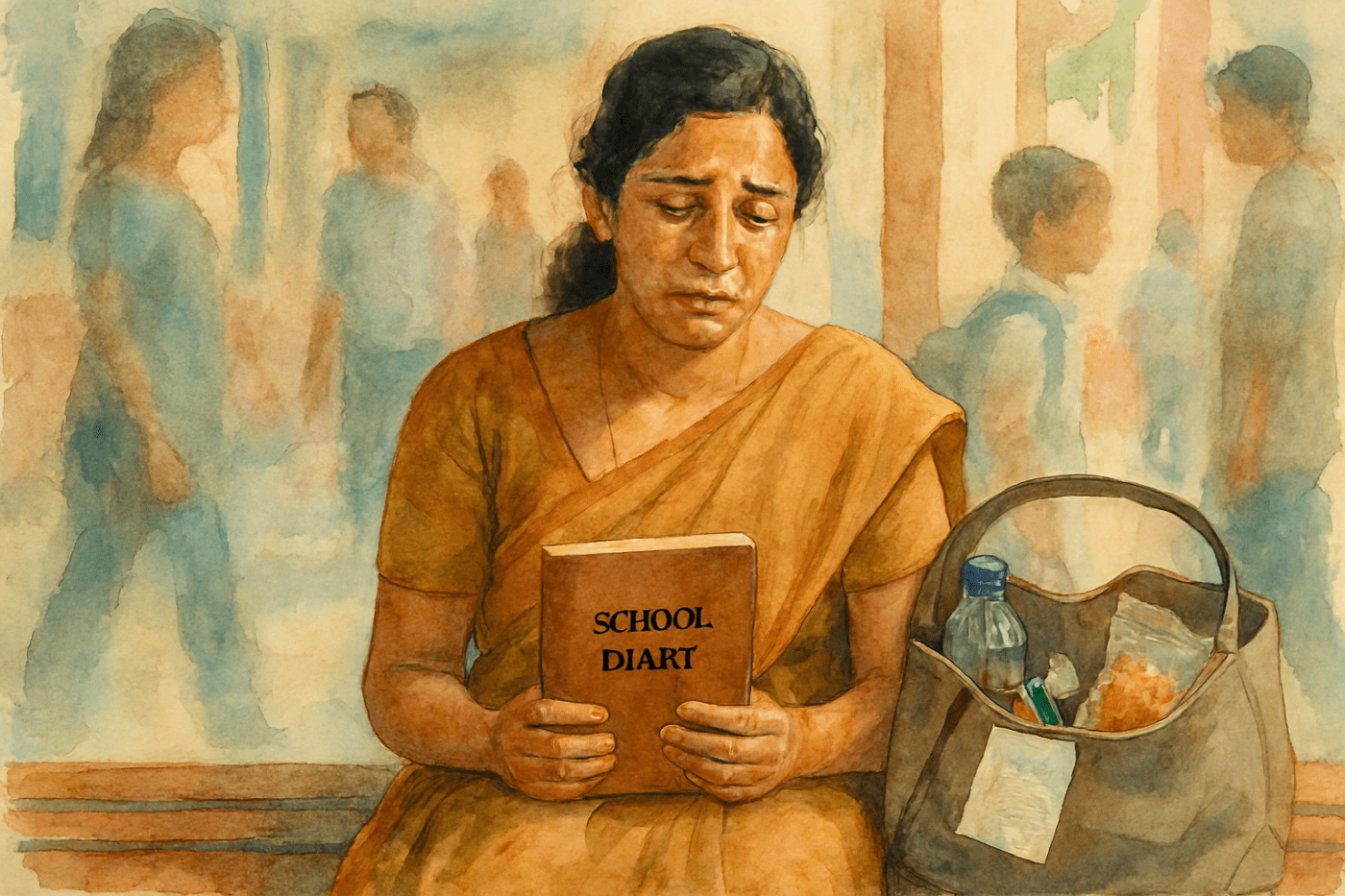
Somewhere between a child’s first cry and their first mistake, an invisible rule is quietly written into society’s handbook: If something goes wrong, ask the mother.
Not the situation. Not the phase. Not the many influences shaping a child.
Just the mother.
A child forgets homework—“What is the mother doing?”
A child talks back—“Didn’t she teach manners?”
A child struggles—“I wonder what kind of mother she has.”
That sentence lands softly on the ears of the speaker, but heavily on the heart of the one receiving it.
Motherhood, apparently, comes with an unspoken job description: full-time caregiver, emotional sponge, moral police, and universal garbage bin—collecting every mistake, every judgment, every raised eyebrow. We are expected to absorb it all silently, compost it into patience, and smile while doing so.
But mothers are humans. Not dustbins.
“There is no handbook for raising humans—only hearts doing their best.”
One missed diary check. One overlooked note. One exhausted day. And suddenly, the entire character of a mother is questioned. Not her intentions. Not her love. Her worth.
And the tears she holds back? They don’t disappear. They settle quietly somewhere inside, waiting for a moment when no one is watching.
What hurts most is not the comment itself, but the assumption behind it—that mothers are deliberately failing. As if we wake up each morning thinking, “How can I mess this up today?” As if love doesn’t coexist with fatigue. As if effort cancels out human limitation.
“Blame is easy. Understanding takes effort.”
Children are not photocopies of their parents. They are complex, curious, impulsive, learning beings shaped by temperament, peers, screens, experiences, and yes—mistakes. Mistakes are not proof of poor parenting; they are proof of childhood.
Yet society often forgets this and hands mothers the emotional bill.
What if, instead of questioning the mother, we asked:
Is she supported? Is she rested? Is she okay?
Because a mother carrying everyone else’s emotional baggage eventually forgets how light her own heart once felt.
So this is a gentle reminder—to every mother reading this:
You are allowed to pause.
You are allowed to feel hurt.
You are allowed to protect your mental health.
You do not have to carry words that were never meant to be yours.
“Taking care of yourself is not selfish; it is survival.”
Let the judgments pass through you, not live inside you. Choose boundaries over guilt. Compassion over self-blame. And remember—your child does not need a perfect mother. They need a present, healing, emotionally safe one.
Thought to Ponder
If mothers are always blamed for children’s mistakes, who takes responsibility for supporting the mothers?
Take care of yourself. You matter—more than the noise ever will 🤍
 Sharon's Read And Reflect
You are really a great mother. Good. God bless you.
LikeLiked by 1 person
Thank you 😊
LikeLike
I felt very emotional while reading this. It’s such a wonderful article. Exactly your correct, Whatever mistake children make, the first person everyone blames is the mother. But no one understands the mother’s inner feelings. She needs support not blame.
LikeLiked by 1 person
Thank you so much for appreciating my blog 💕💕🌈. Mothers carry a lot silently—questions, expectations, and judgments. Emotional support can be far more powerful than blame.
LikeLike