
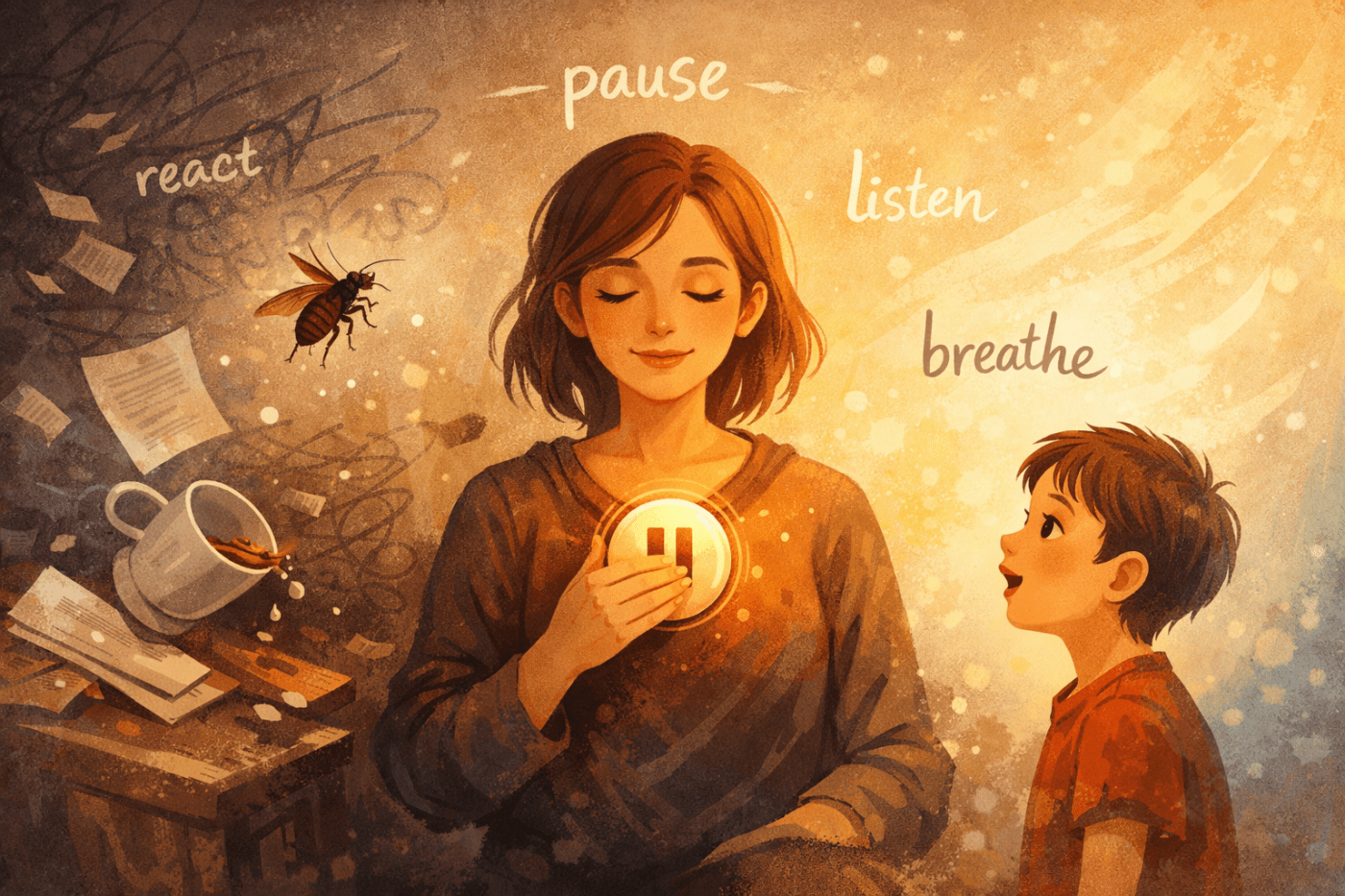
Have you ever noticed how one tiny moment can hijack your entire day? A sharp tone from a colleague. A spilled glass of milk. A child beginning a sentence with “Amma…” and before the sentence even reaches the full stop—boom—we explode. That, dear reader, is not personality. That is reaction.
I once came across something called the Cockroach Theory, shared by Sundar Pichai, and it stayed with me like a quiet truth that refuses to leave. The idea is simple: when a cockroach flies into a room, people react—screaming, jumping, breaking glasses, hurting themselves. The cockroach didn’t cause the chaos. The reaction did.
Reaction is instant. It is emotional fast food—quick, satisfying for a moment, and often regretted later. Response, on the other hand, is home-cooked wisdom. It takes time, thought, and patience.
Books have gently warned us about this pause. Viktor Frankl writes,
“Between stimulus and response, there is a space. In that space is our power to choose.”
That tiny space is where maturity lives. Unfortunately, it is also the space we forget most often—especially at home.
I remember an incident that taught me this lesson very clearly. When my firstborn was around six years old, my mother and I were discussing that the milk powder for my second child had finished. We were so absorbed in our conversation that we didn’t notice my daughter had stepped out. Suddenly, panic took over when we couldn’t find her. I rushed downstairs and found her at the pharmacy in our building, confidently telling the shopkeeper, “Give me a Nan box, my mummy will come and pay.” I brought her home and reacted with anger—shouting and scolding—only to later ask why she did it. Her simple answer was, “I wanted to help you.” In that moment, I realized my mistake. What she did was wrong, but her intention was pure. I should have asked before reacting, explained the situation calmly, and helped her understand instead of making her feel bad. That day, I truly learned the difference between reacting and responding.
At home, reactions come fastest. Children tell stories that start in the middle, skip logic, and end nowhere. Before they finish, our mind fills in the blanks—usually with worst-case assumptions. We react. Later, when the truth surfaces, regret quietly enters the room.
In The Book You Wish Your Parents Had Read, Philippa Perry reminds us that parenting is not about correcting children all the time, but about regulating ourselves first. Presence requires pause. Pause creates response.
Reaction says, “How dare you?”
Response asks, “Help me understand.”
Reaction wants to win the moment.
Response wants to protect the relationship.
Responding does not mean being soft or permissive. It means being conscious. It means choosing words that teach instead of wounds that linger.
The next time a cockroach flies into your mental room—in the form of a mistake, a tantrum, or an unfinished sentence—remember this: you are not responsible for the trigger, but you are responsible for what follows.
Thought to Ponder
What would change in your relationships if you replaced just one reaction a day with a response?
Sometimes, growth isn’t about learning something new.
It’s about unlearning the rush to react.
 Sharon's Read And Reflect
Leave a comment