
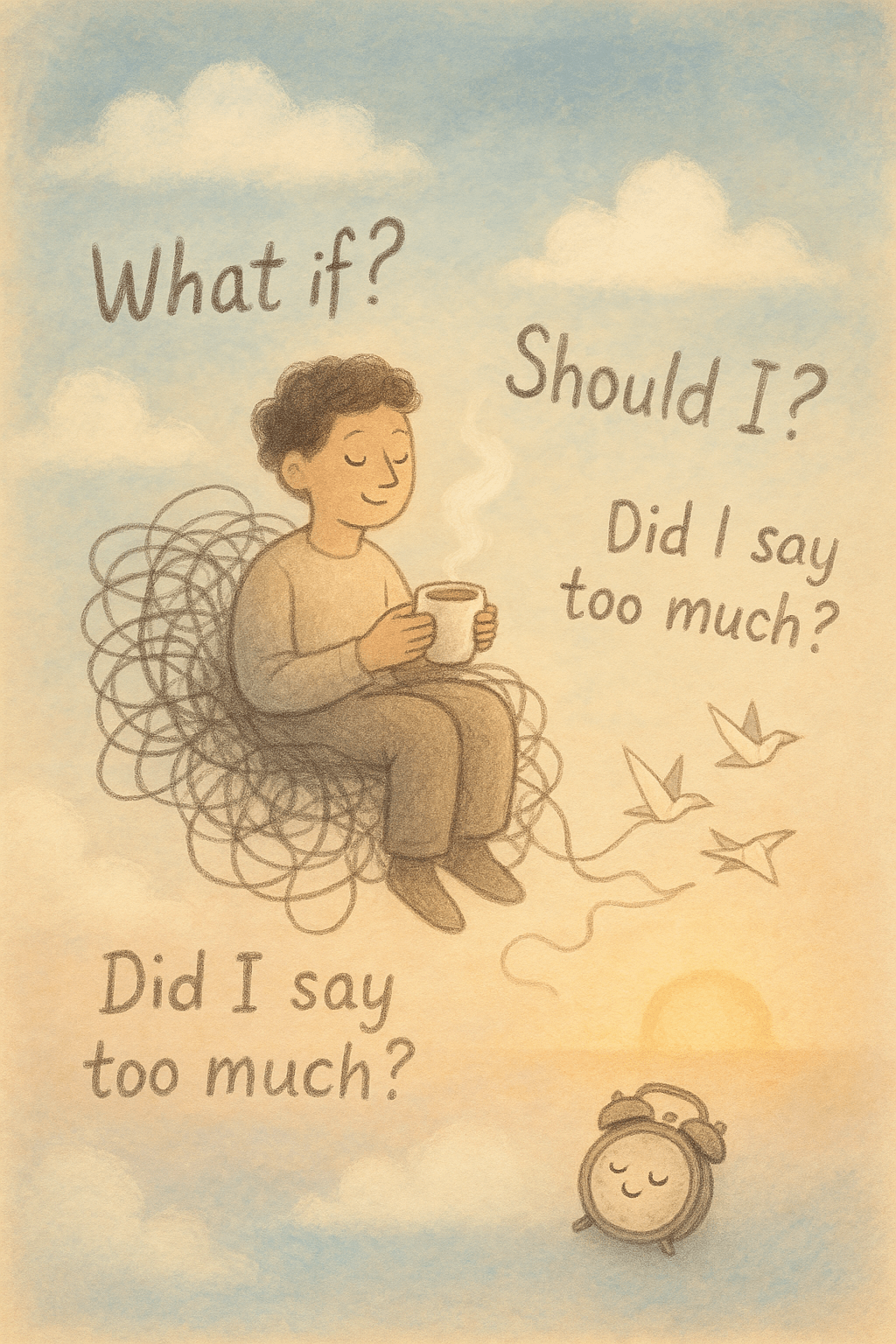
Overthinking is not thinking deeply.
It is thinking repeatedly, like reheating yesterday’s tea again and again, hoping it will somehow taste better this time.
Psychologically speaking, overthinking is the brain’s attempt to protect us. Your mind believes that if it keeps running scenarios—What if I said the wrong thing? What if tomorrow goes wrong? What if I should have done better?—it can prevent pain. Ironically, this protective mechanism often becomes the very source of anxiety.
As one wise (and tired) brain might whisper:
“I am not overthinking. I am just thinking in HD, with surround sound, and unlimited replays.”
Overthinking usually has three favourite playgrounds:
- The past, where it edits scenes that are already released.
- The future, where it writes horror scripts with zero evidence.
- The self, where it acts like a harsh critic who never takes a day off.
Psychology calls this rumination—the habit of looping thoughts without moving toward resolution. The brain gets stuck not because the problem is big, but because certainty feels safer than silence. An unanswered question makes the mind uncomfortable, so it fills the gap with assumptions.
Here’s the catch:
“The mind hates uncertainty, but the soul thrives in trust.”
Why Overthinking Feels So Convincing
Overthinking often disguises itself as responsibility. It says, “If you care, you must think more.” But caring is not the same as worrying. One leads to action; the other leads to exhaustion.
Your brain is a powerful tool—but it was never meant to be a courtroom where you are both the accused and the judge.
Gentle, Psychology-Backed Solutions (That Don’t Require Becoming a Monk)
1. Name the Thought, Don’t Become It
Instead of “I am a failure”, try “I’m having a thought that I failed.”
Distance reduces emotional charge.
2. Set a ‘Worry Window’
Tell your mind, “You get 15 minutes at 7 pm.”
Funny thing—most worries don’t even show up on time.
3. Engage the Body
Overthinking lives in stillness. Movement—walking, stretching, even washing dishes—interrupts the loop.
4. Ask One Powerful Question
“Is this thought helping me right now?”
If not, it deserves less attention.
5. Practice Mental Minimalism
Not every thought needs analysis. Some need a polite nod and a firm exit.
As someone once said,
“Your thoughts are visitors. You decide who gets tea and who gets shown the door.”
The Quiet Truth
Life is not solved by thinking harder. It is lived by showing up—messy, uncertain, imperfect. Overthinking tries to control life; peace comes from cooperating with it.
And remember:
“You don’t need to figure out your whole life tonight. Your brain just forgot it’s allowed to rest.”
🌙 Thought to Ponder
If overthinking were removed from your life for just one day,
what space would open up—and what would you gently place there instead?
 Sharon's Read And Reflect
Leave a comment