
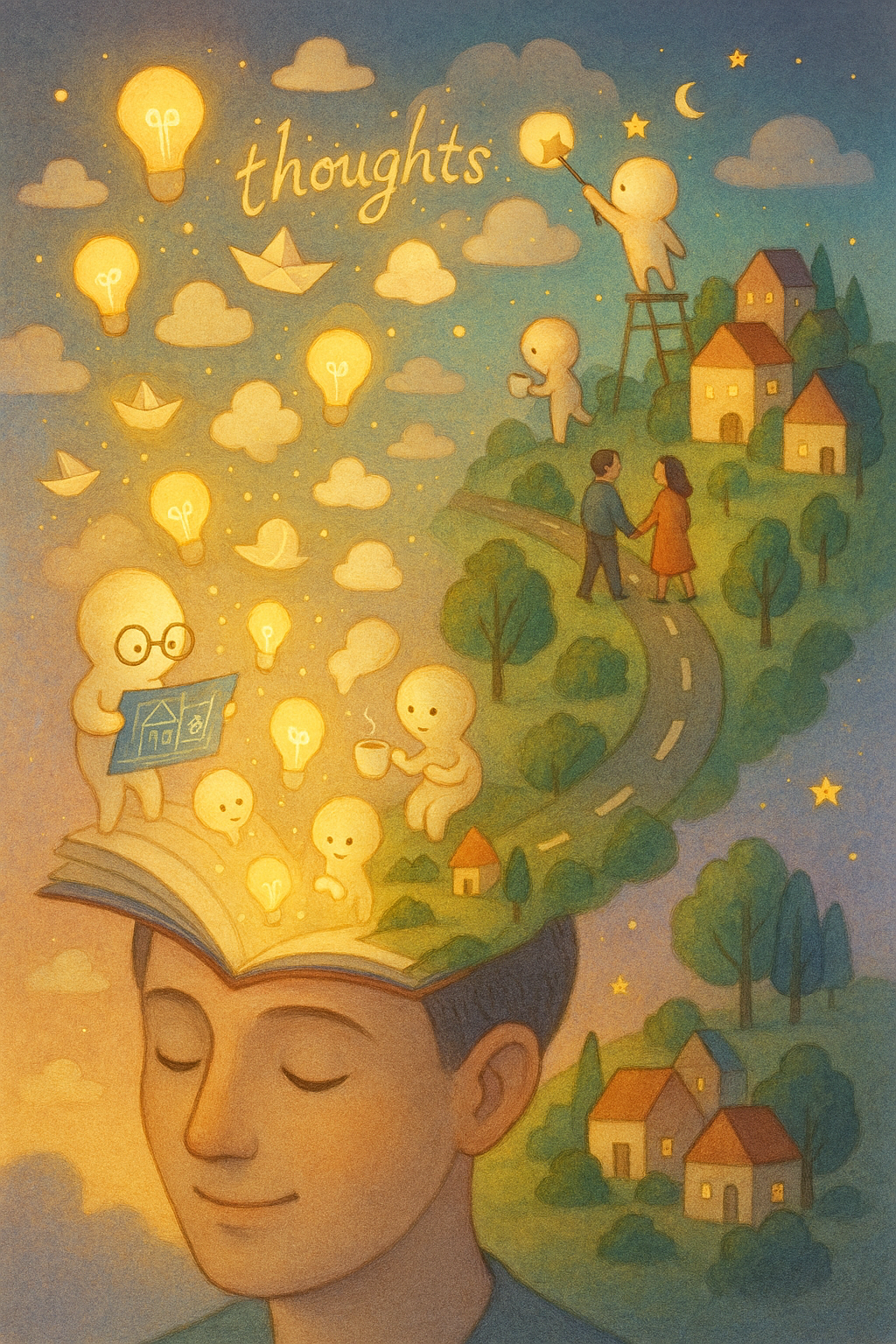
Reality is often blamed for our moods. “The day was bad.” “People are difficult.” “Life is unfair.” But what if reality is just a polite waiter, serving whatever dish our thoughts order—without questioning the recipe?
Every morning, before the world even clears its throat, our thoughts wake up first. They stretch, yawn, and whisper predictions. Today will be exhausting. Or, Today might surprise me. Strangely, the day listens.
Thoughts are not loud dictators; they are subtle interior decorators. They rearrange the furniture of our minds and, over time, we begin to live exactly as the room is arranged. A chair placed in the corner becomes “the thinking spot.” A crack in the wall becomes “proof something is broken.” Soon, we stop noticing the windows.
“Your mind is a lens, not a mirror,” someone once said. “It doesn’t reflect life as it is; it bends light into meaning.”
Consider two people stuck in the same traffic jam. One fumes, rehearsing arguments with imaginary drivers. The other notices the sky, finishes a podcast episode, maybe even smiles at a street dog enjoying the shade. Same road. Same delay. Different realities. The traffic didn’t change—thoughts did.
Humour lives here too. The mind loves exaggeration. A single mistake becomes “I always mess up.” One awkward conversation turns into “Everyone thinks I’m weird.” The brain is a drama writer who never met an editor. If thoughts were paid per sentence, we’d all be bankrupt.
But here’s the hopeful twist: the same mind that dramatizes can also redesign.
When you think “I’m learning,” instead of “I’m failing,” reality softens. When you think “This is uncomfortable but temporary,” the moment loses its teeth. Thoughts don’t magically erase problems, but they decide whether a problem is a prison or a puzzle.
“Our thoughts are seeds,” an old proverb-like whisper goes. “Water them with attention, and don’t be surprised by the forest.”
This doesn’t mean forced positivity or pretending pain doesn’t exist. It means choosing honesty without cruelty. Saying, “This hurts, but I can handle it,” instead of “This hurts, and I’m doomed.” Reality responds differently to courage than it does to condemnation.
Even the body listens. A worried mind tightens shoulders. A hopeful thought slows breathing. Over time, reality isn’t just shaped outside—it settles inside us.
Perhaps the world isn’t happening to us as much as it’s happening through us.
So the next time reality feels heavy, pause. Ask yourself: What thought did I hand the steering wheel to today?
Because thoughts may be invisible, but they leave fingerprints everywhere.
Thought to Ponder:
If your thoughts were writing tomorrow’s reality tonight, would you let them repeat old drafts—or invite them to imagine something kinder?
 Sharon's Read And Reflect
Leave a comment