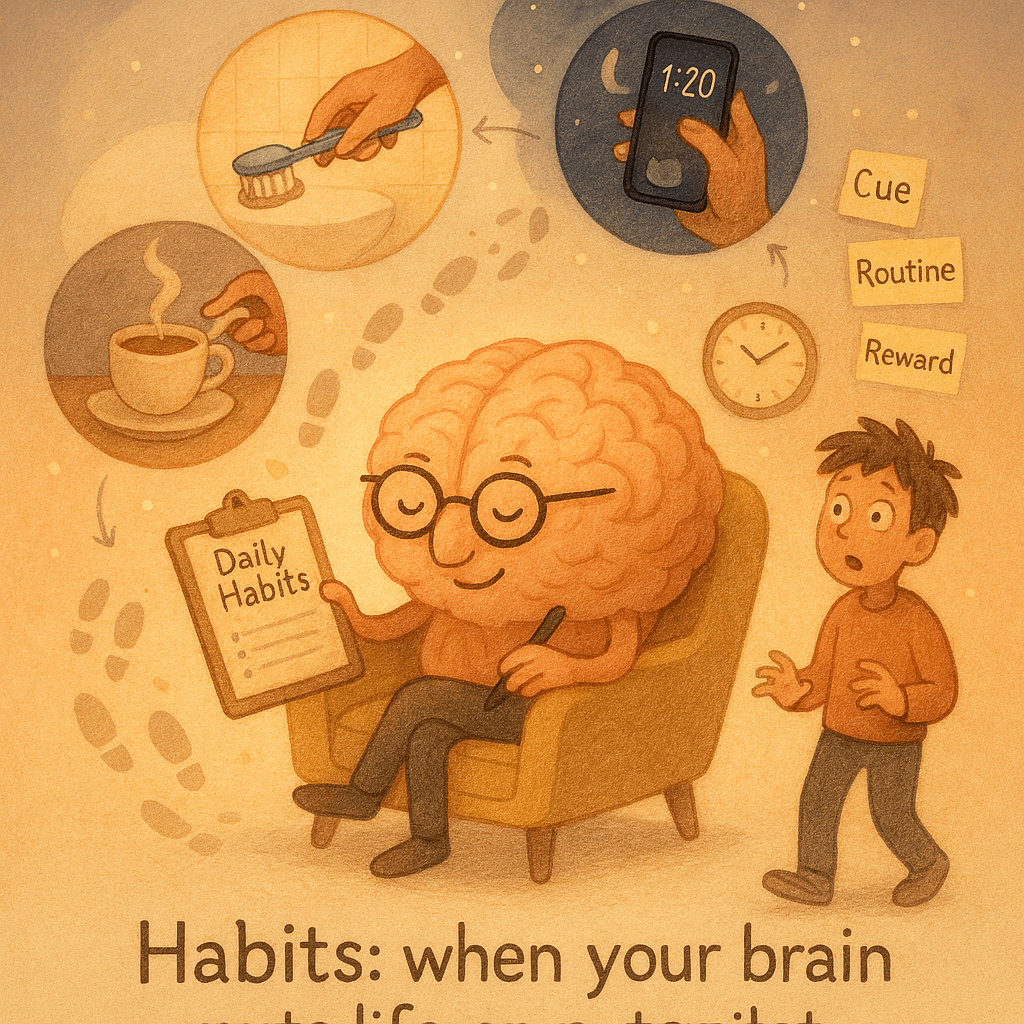
Every morning, your brain wakes up before you do. It reaches for the toothbrush, pours tea the same way, unlocks the phone with muscle memory, and hums a tune you don’t remember choosing. Congratulations—you’ve been outsourced. To habits.
Habits are the brain’s favorite shortcut. Thinking is expensive; habits are budget-friendly. So the mind quietly files repeated actions into a mental drawer labeled “Don’t Ask, Just Do.” That drawer is powerful. It can turn chaos into calm—or quietly rearrange your life without permission.
Here’s the funny part: habits don’t care whether they are good, bad, or ridiculous. The brain doesn’t judge; it only counts repetitions.
As one might say, “The brain doesn’t ask, ‘Is this wise?’ It asks, ‘Is this familiar?’”
A habit begins innocently. One late night becomes two. One scroll becomes a lifestyle. One “I deserve this” snack gets promoted to daily management. The brain notices the pattern, nods approvingly, and says, “Ah yes, this again.” Before you know it, you’re living a routine you never consciously signed up for.
But habits are not villains. They are loyal employees—just poorly supervised. They brush your teeth without debate, drive you home while your mind daydreams, and help you survive busy days without decision fatigue.
“Habits are the invisible hands holding our lives together,” even when the stitching is a little crooked.
The psychology of habits lies in a simple loop: cue, routine, reward. A feeling triggers an action, which delivers a payoff—comfort, relief, familiarity. The brain loves rewards, especially predictable ones. It would rather choose a small, certain comfort today than a big, uncertain benefit tomorrow. That’s why habits feel stronger at night, during stress, or when willpower is tired and hiding.
Changing a habit, then, isn’t about fighting yourself. It’s about negotiating with your brain. You don’t erase a habit; you replace its job description. Same cue, new routine, similar reward.
Because “The brain resists deletion but accepts upgrades.”
The most surprising truth? Habits don’t shape our days. They shape who we become. Tiny actions, repeated quietly, vote for the person we are turning into—without applause, without drama.
Thought to ponder:
If your habits are writing your life story in invisible ink, what kind of person will appear when the words finally show?
 Sharon's Read And Reflect
Well said – the book Atomic Habits goes into detail on the science behind the habits and how to create new ones that are beneficial and how to get away from those that are not good for us. The book has been around for a while but I got a chance to read it quite recently. I cannot recommend it enough.
LikeLiked by 2 people
Thank you 😊 Yes it’s a great book.
LikeLiked by 1 person