
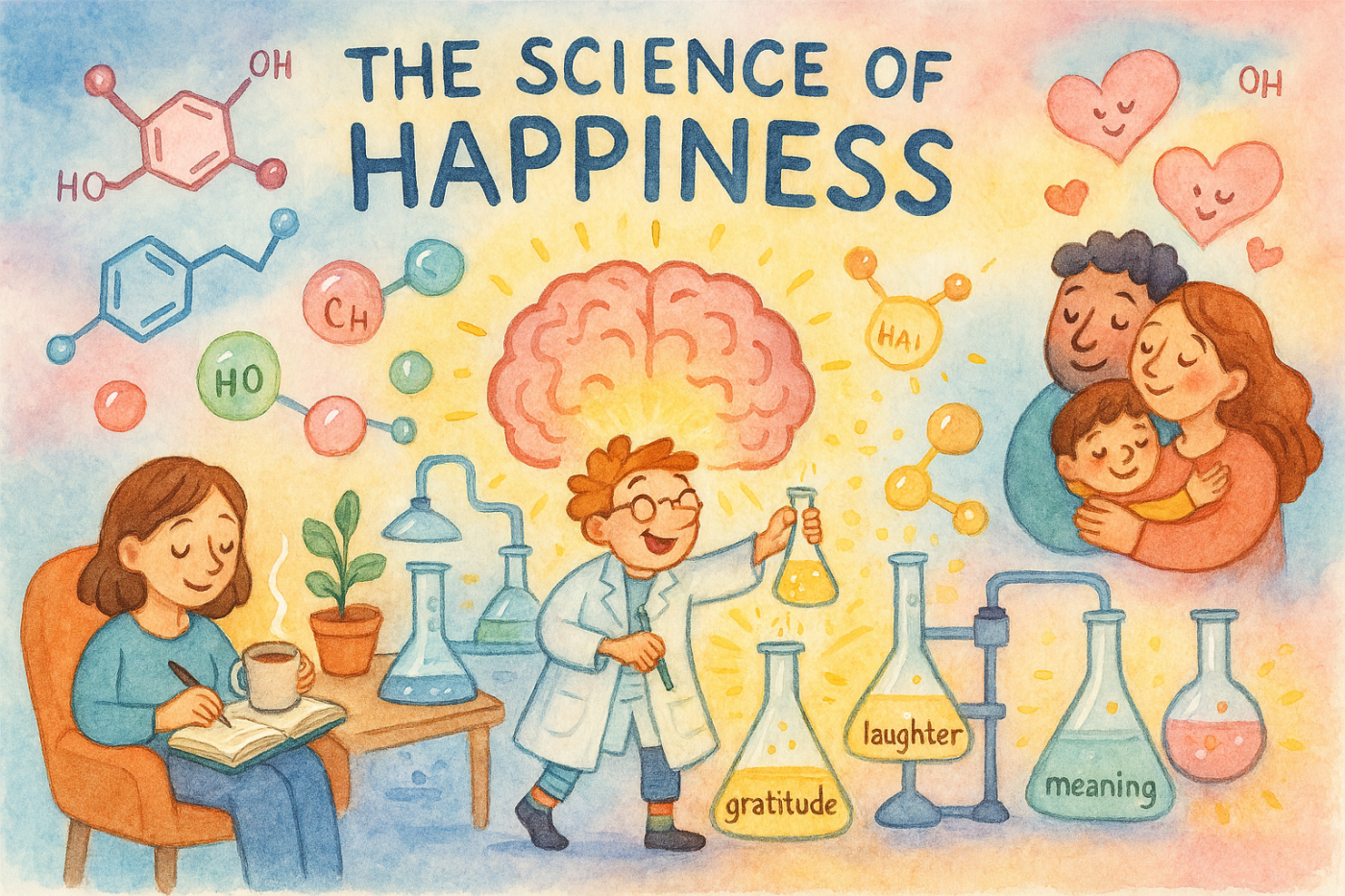
If happiness had a lab report, it would probably start with: “Observation: Humans chase happiness like kids chase ice cream trucks.” But the science of happiness isn’t about chasing anything—it’s about understanding how joy is wired into our brains, habits, and tiny everyday choices.
Scientists say happiness is 50% genetic, 10% circumstance, and 40% what we do daily. That 40% is great news—because it means even if you didn’t wake up as the “sunshine-and-rainbows” type, you can still learn to become happier. As Victor Frankl wrote in Man’s Search for Meaning, “Everything can be taken from a man but one thing: the last of the human freedoms—to choose one’s attitude.” Turns out, choosing happiness is very much a science-supported attitude.
Happiness Has Chemistry
Your brain comes with its own happiness factory. Dopamine (the reward chemical), serotonin (the mood stabilizer), oxytocin (the love hormone), and endorphins (your natural painkillers) form the “Fantastic Four.” They don’t wear capes, but they do make you feel like you’re floating when you receive a compliment, hug your child, enjoy chocolate, or finish a task you were dreading for a week.
Interestingly, even anticipating something pleasurable boosts dopamine. That’s why booking a vacation often feels almost as good as going on one. Sometimes better—because the vacation includes long waiting lines, sunburns, and children asking “Are we there yet?” 114 times.
The Joy Equation: Attention + Meaning
In The Happiness Project, Gretchen Rubin writes, “What you do every day matters more than what you do once in a while.” Happiness sneaks into your life through small daily rituals: morning walks, warm tea, silly conversations, listening to your favorite song… and yes, ignoring WhatsApp family groups for mental stability.
Psychologists emphasize that attention plays a huge role. Happiness grows where attention goes. When we consciously notice the good—like the last bite of dessert or your kid’s “almost straight” handwriting—your brain forms what researchers call positive emotional micro-moments. Over time, they compound like interest in a bank account (if banks still gave interest worth noticing).
Gratitude & Kindness: The Hidden Superpowers
Studies show writing just three things you’re grateful for can rewire your brain in 21 days. Acts of kindness—helping a stranger, complimenting someone, or letting your spouse have the last slice of pizza (rare, but noble)—release oxytocin and make both giver and receiver happy. A double win, without gym fees.
A friend once told me, “I thought buying a car would make me happier, but honestly, talking to my plants gives me more peace.” And science agrees—nature reduces cortisol, improves mood, and makes life feel slower and sweeter, like good filter coffee.
A Thought to Ponder
If happiness is a science, then perhaps the real experiment is this:
Are we spending our minutes on things that create joy… or on things that merely distract us from it?
 Sharon's Read And Reflect
Leave a comment