
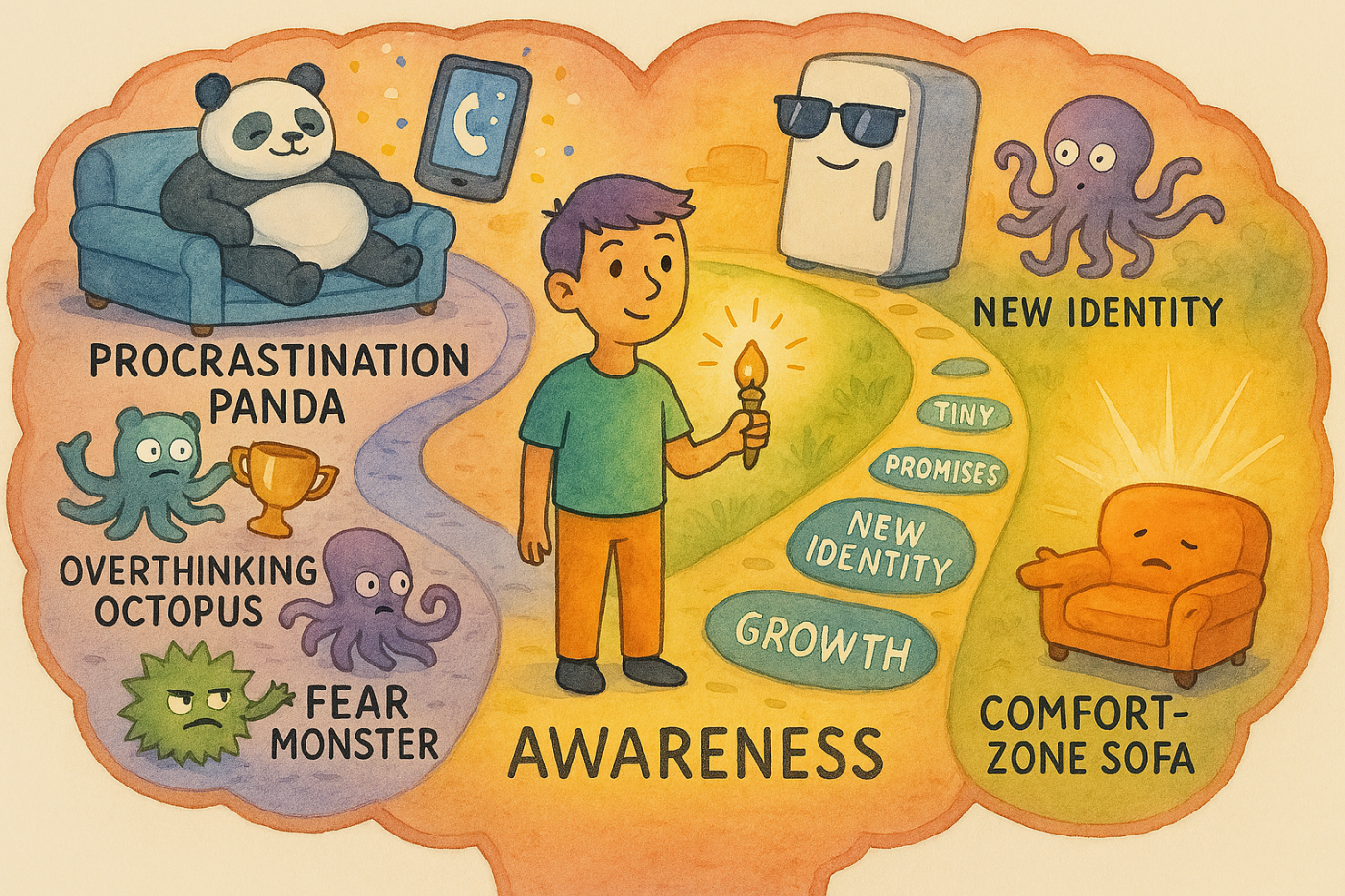
Have you ever noticed how humans behave like that one WiFi signal—strong when no one needs us, and conveniently weak when it’s time for something important? That, my friend, is self-sabotage: our brain’s dramatic way of tripping us just before the finish line.
We know what we should do. We know what will help us grow. And yet, when the moment comes…
we binge on chai, scroll reels, rearrange the wardrobe, or suddenly develop deep concern for that broken button we ignored for six months.
“The mind is a brilliant storyteller… until it narrates against you.”
Self-sabotage is not laziness; it’s protection gone wrong. Our brain hates uncertainty. So the moment we try to step into a new version of ourselves—start a business, lose weight, speak up, love again—our inner alarm system screams, “RETREAT! Danger ahead!” even if the only danger is success.
Why We Self-Sabotage
1. Fear of Success
Sounds strange, but success demands responsibility. If we rise higher, people expect more from us, and we expect more from ourselves. Sometimes it feels easier to stay safely average than risk shining brightly.
2. Fear of Failure
This one is classic. If we don’t try fully, we can always say, “See? I didn’t fail. I just didn’t give my best.” It’s a clever trick…but also a prison.
3. Overthinking – The Silent Villain
We think so much about what can go wrong that we never step into what can go right.
Imagine a plant thinking, “What if sunlight burns me?” It would never grow.
4. Old Identity Patterns
Your past version loves to boss around your present version.
If you’ve always been “the quiet one,” “the one who never finishes anything,” or “the one who plays it safe,” your brain will push you back into that box every time you try to break free.
5. Comfort Zone = Sticky Zone
Comfort zones are like sticky sofas. The longer you sit, the harder it is to get up.
Self-sabotage thrives in comfort.
How to Stop Self-Sabotaging
1. Notice the Pattern
You can’t fix what you don’t notice. Observe your triggers—do you procrastinate right before important tasks? Do you attract toxic people when you’re healing? Awareness is everything.
2. Make Tiny Promises to Yourself
Not big goals. Tiny ones.
A 5-minute walk.
A 10-minute task.
A single page of reading.
Tiny promises rebuild self-trust.
3. Rewire the Inner Dialogue
When your mind screams, “What if you mess up?”
Reply: “What if I don’t?”
We underestimate the power of a kinder voice inside us.
4. Prepare for Discomfort
Growth is uncomfortable. Success is uncomfortable. Healing is uncomfortable.
But so is staying stuck.
Choose your discomfort wisely.
5. Celebrate Micro-Wins
Finished something? Celebrate.
Didn’t quit today? Celebrate.
Your brain repeats what feels rewarded.
“Small victories build big identities.”
Thought to Ponder
If you had zero fear—no fear of failing, no fear of succeeding, no fear of judgment—
what would your next step be?
And more importantly…
what’s stopping you from taking it today?
 Sharon's Read And Reflect
Leave a comment